
Use of English Test: Practice Guide
If you’ve ever taken a Cambridge exam or a general English placement test, you’ve probably run into a section called “Use of English.” It’s one of the most common (and most misunderstood) parts of any English proficiency test. This guide explains what it actually measures, how it’s structured at each CEFR level, and how you can practice it for free.
What Is the “Use of English” Test?
Use of English is the part of an English exam that tests your grammar and vocabulary in context, rather than testing them in isolation. Instead of asking “what is the past tense of ‘go’?”, it asks you to complete a real sentence, fix an error in a paragraph, or rewrite a sentence with the same meaning using different words.
It’s essentially a precision test: can you choose the one correct word or structure out of several plausible options? That’s why it’s often considered the most challenging section of a language exam. It rewards accuracy, not just general comprehension.
Use of English is not a separate exam on its own. It’s a core component of the grammar and vocabulary section of most structured English tests, including the TrackTest English Core test, where it’s the first section you complete.
How the Use of English Section Is Structured
In the Tracktest English Core test, Use of English tasks use the task format of Multiple-choice cloze – choose the correct word to fill each gap in a text (usually 3–4 options per gap).
Use of English by CEFR Level
The grammar and vocabulary tasks tested in the Use of English section changes significantly between levels. Here’s what to expect at each stage.
A2 Use of English
At A2, Use of English focuses on foundational grammar: present and past simple, basic prepositions, common irregular verbs, comparatives, and everyday vocabulary (family, routines, shopping, travel). Sentences are short and the context is concrete and familiar.
B1 Use of English
At B1, tasks introduce more complex tenses (present perfect, past continuous, first conditional), a wider range of connectors (although, despite, in order to), and phrasal verbs. You’re expected to recognize subtler differences between similar words and structures.
B2 Use of English
At B2, the section becomes noticeably harder: second and third conditionals, passive voice, reported speech, a broader range of phrasal verbs and idiomatic expressions, and word formation involving prefixes and suffixes. This is typically where test-takers see the biggest jump in difficulty compared to B1.
Why Use of English Trips People Up
Most learners can hold a conversation or read a text without major issues, but Use of English exposes gaps that don’t show up in everyday communication. Common problem areas include:
- Choosing between near-synonyms (e.g., “make” vs. “do”)
- Prepositions that don’t translate logically from your native language
- Collocations (word pairings that “sound right” only if you’ve seen them before)
- Verb patterns (gerund vs. infinitive after certain verbs)
Because these are pattern-recognition skills built through exposure, the most effective way to improve is consistent, level-appropriate practice, not just reading grammar rules.
Practice Use of English for Free
You can practice Use of English questions at your level with TrackTest’s free downloadable practice tests, each including full answer keys:
- A2 English practice test with answers
- B1 English practice test with answers
- B2 English practice test with answers
If you want to focus specifically on grammar fundamentals before tackling full Use of English tasks, try the free English grammar placement test, a short adaptive test that estimates your CEFR level based on your grammar and vocabulary responses.
Take the Full Test
Use of English is the first section of the TrackTest English Core test, which also assesses reading and listening comprehension. Complete it to get an official CEFR-aligned result (A1–C2) with a downloadable certificate or add the optional Speaking & Writing module for a full four-skills assessment.
Frequently Asked Questions
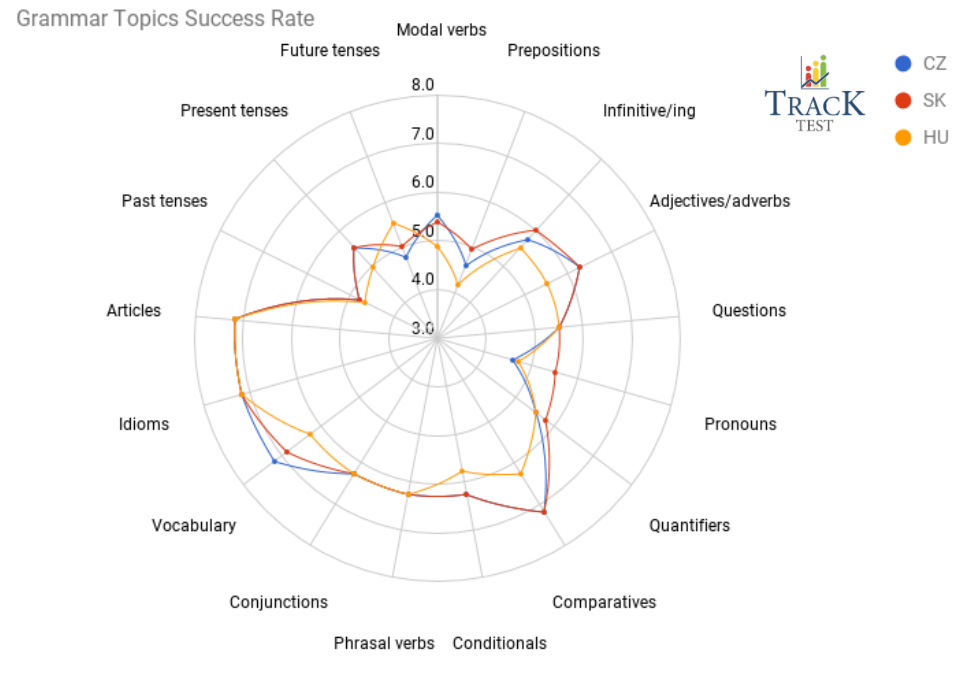
Not exactly. A grammar test usually checks isolated rules, while Use of English checks whether you can apply grammar and vocabulary correctly within realistic sentences and texts- closer to how language works in practice. In the Tracktest English Core test, you will find your success rate of Use of English tasks in the Grammar section of the test report.
If you’re unsure of your level, start with the free grammar placement test, which gives you a quick estimate before you commit to a full-length CEFR A2, B1, or B2 test.
Yes, each level’s practice test above is available as a free downloadable PDF with a full answer key, so you can self-check your results.
Test your Use of English skills
Try the grammar and vocabulary tasks in our free pre-test